

⏱️ Reading Time: 8 Minutes
📖 At a Glance
Best For: Kenyan used-car buyers, first-time buyers, importers, luxury-car shoppers, performance enthusiasts, and anyone considering purchasing a second-hand vehicle.
🔑 Key Takeaways
- A clean-looking car isn’t necessarily accident-free.
- Modern cars can store useful diagnostic information.
- Airbag and safety-system faults can reveal previous collision damage.
- ADAS sensors may require calibration after an accident.
- Paint and body inspection can reveal repaired panels.
- Diagnostic scanning should complement—not replace—physical inspection.
- Imported vehicles deserve especially careful inspection.
- Kenyan buyers should be cautious of vehicles repaired cheaply after major accidents.
- A professional pre-purchase inspection can save you from expensive surprises.
🚘 The Car Looks Perfect. But Is It Really?
Imagine this.
You find a beautiful used car.
The paint looks fresh.
The interior is clean.
The engine sounds good.
The seller tells you:
“Very clean car. No issues.”
You take it for a short drive.
Everything feels fine.
You’re ready to pay.
But there’s a problem.
You may be looking at a vehicle that has previously been involved in an accident.
And the repairs may have been good enough to hide the evidence from an ordinary buyer.
This is where modern technology becomes extremely useful.
Today’s vehicles contain computers, sensors and electronic systems that can provide clues about what has happened to the car.
But here’s the important part:
Technology is not magic.
A diagnostic scanner cannot tell you everything.
The smartest inspection combines:
Technology + Mechanical Inspection + Body Inspection + Vehicle History
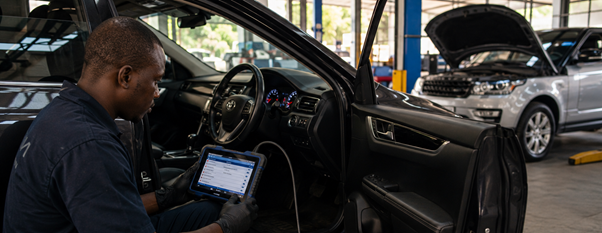
💻 1. The Diagnostic Scanner: Your First Electronic Detective
Modern vehicles have multiple electronic control units.
Depending on the vehicle, these may control:
- Engine.
- Transmission.
- Airbags.
- ABS.
- Stability control.
- Parking sensors.
- Cameras.
- Driver-assistance systems.
- Body electronics.
A diagnostic scan can reveal stored fault codes.
For example, a vehicle may show problems relating to:
- Airbag systems.
- ABS sensors.
- Wheel-speed sensors.
- Radar sensors.
- Parking systems.
This doesn’t automatically prove that the vehicle has been in an accident.
A sensor can fail for many reasons.
But when several clues appear together, they deserve investigation.
For example:
Previous body repair + airbag fault + damaged sensor + mismatched paint
is much more significant than one isolated warning code.
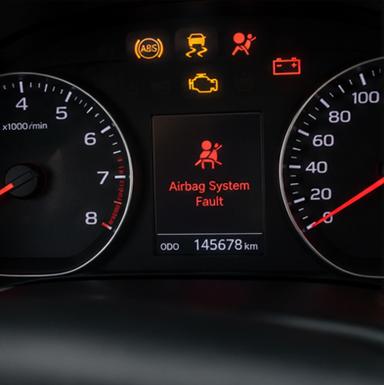
🛡️ 2. Airbags Can Tell an Important Story
Airbags are designed to deploy during certain types of serious collisions.
When they deploy, repairs may involve replacing:
- Airbag units.
- Seat-belt components.
- Airbag control modules.
- Dashboard components.
- Steering-wheel components.
This is why the airbag system deserves special attention when buying a used vehicle.
A warning light on the dashboard is an obvious clue.
But the absence of a warning light doesn’t necessarily guarantee that everything is original.
Some badly repaired vehicles may have had components replaced or systems tampered with.
This is why a qualified technician should inspect the system properly.
Never compromise on safety systems simply because the car looks good.
🚨 3. ADAS Sensors Can Reveal Previous Damage
Modern vehicles may have sensors located behind:
- Front bumpers.
- Grilles.
- Windscreens.
- Side mirrors.
- Rear bumpers.
These sensors can support systems such as:
- Adaptive cruise control.
- Blind-spot monitoring.
- Automatic emergency braking.
- Lane assistance.
- Parking assistance.
Here’s the important Kenyan buying lesson:
A small-looking bumper accident can sometimes affect expensive technology hidden behind the bumper.
The bumper may have been repaired beautifully.
But the radar sensor may have been damaged.
Or it may require calibration.
This is why buyers of modern vehicles should test the electronic safety systems before purchasing.
🎨 4. Paint Can Tell You More Than You Think
Technology isn’t only about computers.
Sometimes the simplest tool can be extremely useful.
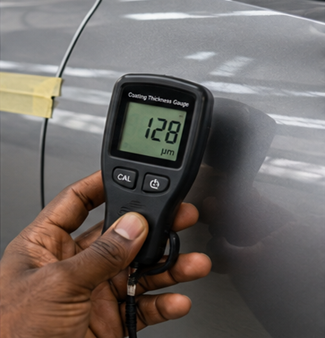
A paint-thickness gauge can help identify areas where body panels may have been repainted.
If one panel has significantly different paint thickness from neighbouring panels, it may deserve further investigation.
It doesn’t automatically mean the car was badly damaged.
A panel could have been repainted for many reasons.
Perhaps it had scratches.
Perhaps there was minor damage.
Perhaps the previous owner simply wanted to refresh the paint.
The important thing is to ask:
Why was this panel repainted?
Then investigate further.
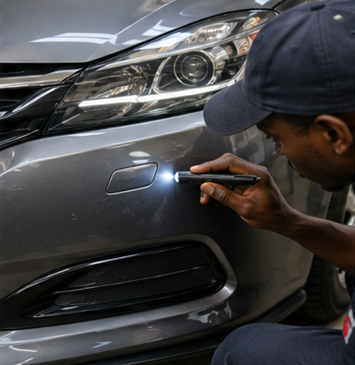
🔍 5. Panel Gaps Are Another Important Clue
Walk around the vehicle.
Look carefully at the gaps between:
- Bonnet and fenders.
- Doors and body panels.
- Boot and rear panels.
- Headlights and bodywork.
Are the gaps consistent?
Does one side look different from the other?
Are there signs that a panel doesn’t sit correctly?
Modern manufacturing is highly precise.
Large inconsistencies can indicate previous repairs.
Again, one clue isn’t proof.
But several clues together can tell a much stronger story.
🧩 6. Don’t Forget the Glass
Vehicle glass can provide useful information.
Look at the markings on:
- Windscreen.
- Door windows.
- Rear window.
If one side window appears significantly newer than the others, that may simply mean it was broken and replaced.
But if the windscreen, several windows and body panels all appear to have been replaced, you may want to ask more questions.
The goal isn’t to automatically assume the worst.
It’s to understand the vehicle’s history.
🇰🇪 7. Imported Cars Require Extra Attention
This is particularly important in Kenya.
Many vehicles on the Kenyan market are imported.
Some arrive after years of use overseas.
Others may have experienced accidents before being repaired and exported.
That doesn’t automatically make an imported used vehicle a bad purchase.
Far from it.
Many imported vehicles are excellent.
But buyers should understand that the vehicle’s history may extend far beyond Kenya.
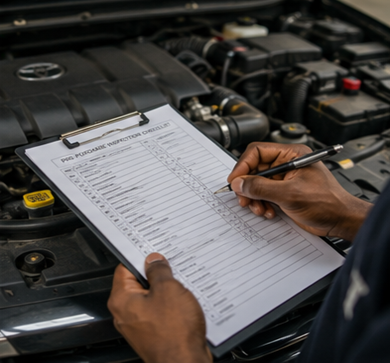
This is why checking available history, auction information where applicable, inspection records and physical condition can be extremely valuable.
Don’t buy the story.
Buy the evidence.
🧠 8. Can a Scanner Detect Everything?
No.
And this is one of the most important things to understand.
A diagnostic scanner is a tool.
It is not a crystal ball.
It may identify:
- Stored fault codes.
- Current faults.
- Sensor problems.
- Communication issues.
- Some system abnormalities.
But it may not tell you:
- Whether a panel was repainted.
- Whether the chassis was properly repaired.
- Whether a mechanical component was poorly installed.
- Whether cosmetic repairs were done badly.
- The complete history of every accident.
That’s why a professional inspection should involve several different approaches.
Electronic Inspection
Scan the vehicle.
Mechanical Inspection
Check the engine, transmission, suspension and brakes.
Body Inspection
Check paint, panels, chassis and alignment.
History Investigation
Look for available records.
Together, these provide a much clearer picture.
🚗 9. What About Chassis Damage?
This is where things become particularly serious.
A vehicle involved in a major collision may suffer structural damage.
A poorly repaired chassis can potentially affect:
- Handling.
- Alignment.
- Tyre wear.
- Stability.
- Safety.
This is not something you should attempt to diagnose simply by looking at the car in a parking lot.
A qualified inspection is essential.
If the inspector discovers evidence of significant structural repair, don’t rush to buy simply because the price is attractive.
A cheap car with major structural problems can become extremely expensive—and potentially unsafe.
💡 TorqueSavvy Insight
The more advanced the car, the more important the inspection becomes.
A modern luxury vehicle may contain dozens of electronic modules and sensors.
A modern hybrid may have high-voltage components.
A vehicle with ADAS may have cameras and radar systems requiring calibration.
So when buying an advanced vehicle, don’t reduce your inspection.
Increase it.
🧰 10. The Kenyan Used-Car Inspection Formula
At TorqueSavvy, the ideal inspection mindset is:
LOOK
Inspect the body, panels, tyres, interior and engine bay.
↓
LISTEN
Listen for unusual engine, transmission and suspension noises.
↓
SCAN
Use professional diagnostic equipment.
↓
TEST
Test the vehicle on the road.
↓
VERIFY
Check available vehicle and ownership information.
↓
ASK
Question anything that doesn’t make sense.
↓
DECIDE
Only then decide whether the vehicle is worth your money.
🚨 5 Warning Signs You Shouldn’t Ignore
1. Multiple warning lights
Don’t accept “they just need resetting” without diagnosis.
2. Different paint shades
Investigate why panels look different.
3. Uneven panel gaps
Look for possible previous repairs.
4. Missing airbags or suspicious dashboard repairs
This requires professional investigation immediately.
5. Seller refuses independent inspection
This is a major red flag.
A genuine seller should generally be comfortable with a reasonable pre-purchase inspection.
🇰🇪 A Word About Sellers
Not every seller hiding something is necessarily a criminal.
Sometimes people simply don’t know the complete history of the vehicle they’re selling.
A dealer may have acquired the car from someone else.
A private owner may not know what happened before they purchased it.
That’s why the inspection shouldn’t be about accusing people.
It’s about protecting yourself.
Trust is good. Evidence is better.
💰 Why Spending Money on an Inspection Makes Financial Sense
Let’s say you spend a relatively small amount on a professional inspection.
You discover the car needs significant repairs.
You walk away.
You may feel disappointed.
But you’ve potentially saved yourself from:
- Expensive repairs.
- Safety problems.
- Difficult resale.
- Unexpected downtime.
- Repeated diagnostic bills.
The inspection fee is therefore not simply an expense.
It’s risk management.
📋 TorqueSavvy Used-Car Technology Checklist
Before buying a modern used vehicle:
- Scan the vehicle electronically.
- Check the airbag system.
- Check ABS and stability-control systems.
- Test parking sensors.
- Test the reverse camera.
- Test ADAS features where equipped.
- Inspect paint consistency.
- Check panel gaps.
- Inspect the chassis.
- Check the engine bay.
- Inspect suspension components.
- Check tyres for uneven wear.
- Test the vehicle on the road.
- Verify available vehicle history.
- Get an independent professional opinion.
🔥 The Biggest Lesson for Kenyan Buyers
Don’t let a beautiful car rush your decision.
A freshly polished vehicle can look incredible.
A detailed interior can make you feel like you’ve found a bargain.
A salesperson can make the purchase feel urgent.
Slow down.
Inspect.
Scan.
Ask questions.
Then decide.
Because when you’re spending hundreds of thousands—or millions—of shillings on a vehicle, five minutes of excitement should never override hours of investigation.
⭐ The Bottom Line
Can technology tell you whether a used car has been in an accident?
Sometimes.
But technology works best as part of a much bigger inspection process.
A diagnostic scanner can reveal electronic clues.
A paint gauge can reveal unusual repairs.
A technician can identify mechanical problems.
A body inspector can spot structural concerns.
Vehicle history can provide additional evidence.
None of these tools should be treated as perfect on their own.
Together, however, they can dramatically improve your chances of understanding what you’re actually buying.
For Kenyan motorists, that’s becoming increasingly important.
Cars are becoming more sophisticated.
Repairs are becoming more technical.
And the cost of getting a major purchase wrong can be enormous.
So before you buy that beautiful used car, remember the TorqueSavvy rule:
Don’t just inspect what you can see. Investigate what the car is trying to tell you.
🚗 TorqueSavvy CTA
Looking for Your First Car?
Don’t know where to start?
Tell TorqueSavvy your budget, preferred vehicle type, location, and what you need the car for.
We can help connect you with options that fit your needs while giving you the information you need to make a smarter decision.
👉 Start your car search with TorqueSavvy.
⚡ TorqueSavvy Question
Would you pay for a professional pre-purchase inspection before buying a used car—even if the seller tells you the vehicle is “perfect”?
Yes or no?
And if you’ve ever bought a used car in Kenya, what is the one thing you wish you had checked first?
